

AI reasoning agents, or AI Scientists, can now generate an experimental strategy in minutes: assay design, condition selection, iteration logic. But that speed is wasted if there's no reliable way to turn the plan into a physical experiment. For organizations pushing design-make-test-analyze (DMTA) cycles toward true closed-loop operation, the hard problem was never generating a good idea, however complex the underlying biology. It's translating that idea into execution, consistently, across instruments, people, and modalities.
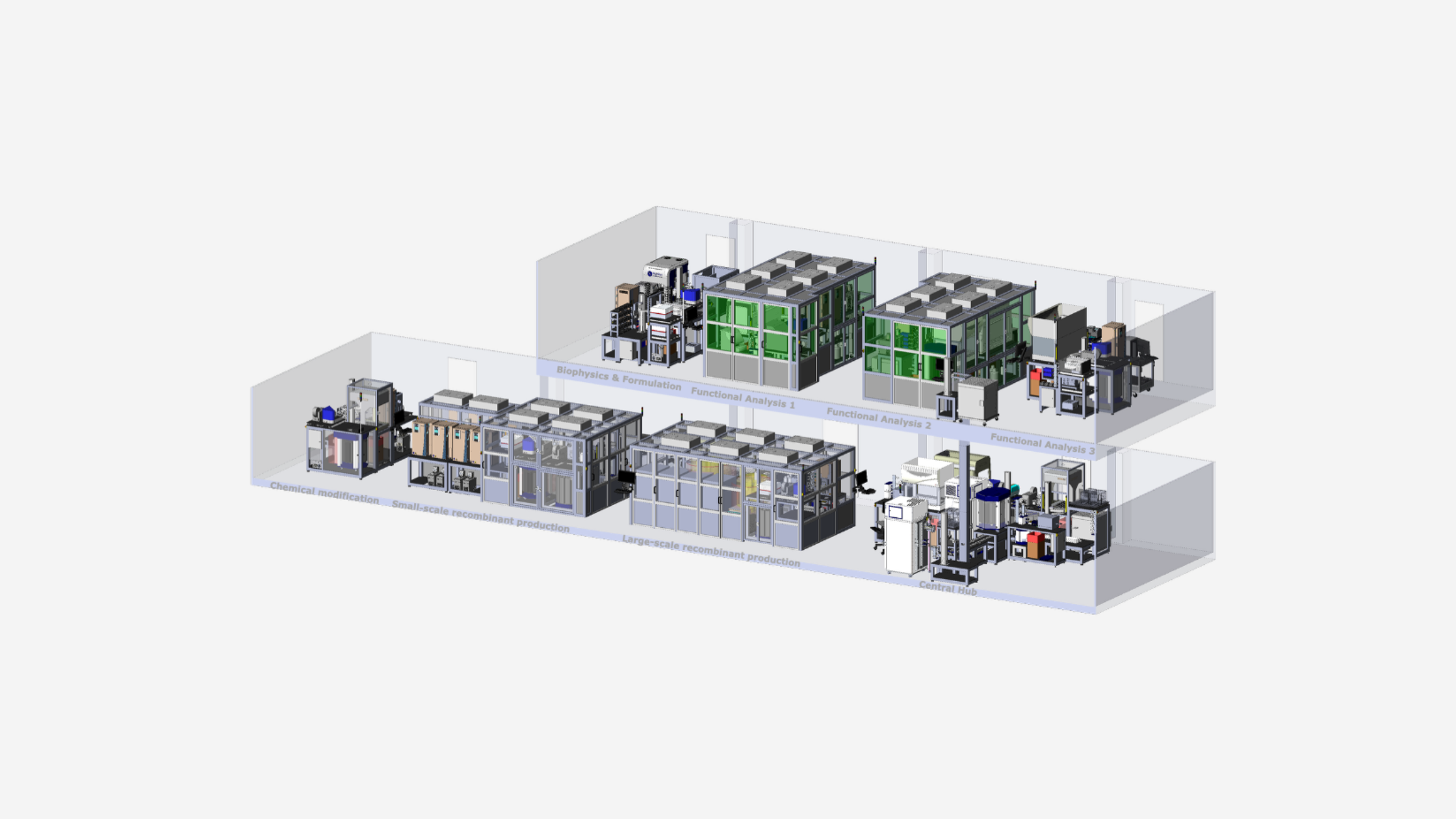
That problem is getting harder, not easier, as more programs extend DMTA principles from small molecule chemistry into large molecule and biologics workflows, alongside the directly comparable Design-Build-Test-Learn (DBTL) cycles used in synthetic biology. HighRes® has pioneered the ability of large pharma to generate data at scale over the last 20 years, with over 800 productive installations, which gives us the relevant experience and expertise to deliver the autonomous lab (Fig. 1).
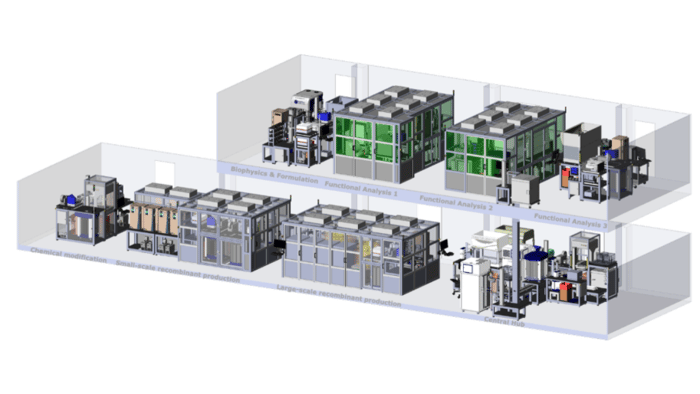
Figure 1. Digital representation of an installed, productive end-to-end antibody discovery lab at a top 20 pharma powered by HighRes lab automation. Nucleus® Lab Automation Systems provide a standardized framework for the automation of a wide range of drug discovery and genomic applications.
How AI Is Actually Being Used in DMTA Today
In most current deployments, AI's role in DMTA sits between the Analyze and Design steps of the cycle: reasoning over prior assay results and structure-activity or structure-function data to propose the next round of molecular designs worth testing. For small molecule programs, that might mean suggesting the next analog to synthesize and which assay panel to run it through. For large molecule programs (e.g., antibody discovery, protein engineering, cell line development) the same reasoning layer has to account for a much wider experimental surface: expression system selection, purification strategy, functional and biophysical characterization, and formulation, often run in parallel rather than in a single linear sequence. That reasoning layer also extends into defining the experimental components of the Make step itself, surfacing literature-derived reaction methodologies for synthesizing a new small molecule, or specifying the DNA sequences to order from vendors for transfecting cells to express a target protein.
In both cases, the AI-generated plan is only a proposal. It still must become a protocol, a schedule, and a set of instrument instructions before a single sample moves.
The Translation Gap
This is where most closed-loop DMTA initiatives stall. An AI-generated plan must be decomposed into protocol steps, mapped to specific instruments and their configurations, scheduled against shared equipment and personnel, converted into a digital SOP, and paired with a clear definition of what data gets captured and how. Each of those steps has historically required manual translation by a scientist or automation engineer.
For small molecule DMTA, that manual translation is a bottleneck on its own: mapping reaction components into plates, specifying and controlling reaction chemistry, and screening and selecting successfully synthesized molecules is a significant translation exercise before a single compound ever reaches functional screening. For large molecule DMTA, it's a multiplier. Biologics workflows typically involve more branching steps (e.g., chemical modification, small- and large-scale recombinant production, multiple parallel functional assays, and formulation) each with its own handoffs and failure points. Hand-translating an AI-generated experimental plan into execution across that many steps reintroduces the exact bottleneck the AI was meant to remove and it does so at a larger scale than most small molecule workflows ever faced.
Where Orchestration Closes the Loop
Orchestration is the layer that closes this gap. Rather than automating a single instrument or a single step, an orchestration platform takes experimental intent, whether generated by a scientist or an AI Scientist and translates it into a structured, executable workflow: protocol decomposition, instrument selection and configuration, scheduling logic, digital SOP creation, and metadata definition. It then coordinates execution across pools of instruments, robotics, and people, and routes the resulting data back to the analysis layer, so the next DMTA cycle starts with better information than the last.
Cellario® connects the physical lab to the digital ecosystem for closed-loop science. We connect the physical lab to the digital ecosystem, closing the loop between analysis/experimental design and wet lab execution through an API-first product design and deep partnerships with ELN, LIMS, Informatics, and AI Scientists.
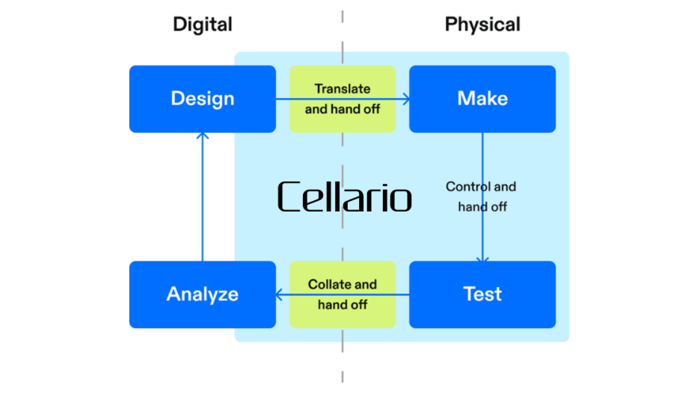 Figure 2. Through our orchestration platform, Cellario Platform, we connect the physical lab to the digital ecosystem, closing the loop between analysis/experimental design and wet lab execution through an API-first product design and deep partnerships with ELN, LIMS, Informatics, and AI Scientists.
This is where scale matters. Organizations running large molecule discovery at production volume are already operating end-to-end antibody discovery labs with this kind of orchestration in place, coordinating functional analysis, chemical modification, and both small- and large-scale recombinant production through a single connected system rather than a collection of standalone instruments. That's a meaningfully different engineering problem than orchestrating a small molecule synthesis-and-screen loop, and it's the reason orchestration platforms built and proven on large molecule complexity are positioned to lead as more pharma and biotech programs make the same shift.
Dynamically Reactive, Self-Healing Labs
Dynamically reactive and self-healing labs are a prerequisite for truly autonomous DMTA. Advancements in the technology in the physical lab are required to increase reliability and accessibility to realize the full potential of the AI scientist and closed loop drug discovery. Without these solutions, hardware reliability and system usability prevented scientists from making use of lab automation (Fig. 2). This is why natural-language interfaces, like Cellario Lab Assistant™, and robotic Perception™, both of which are in early access beta, are starting to make this translation layer more accessible to scientists directly, supporting protocol and workflow generation from plain-language intent, in-flight troubleshooting, and data and insight requests (Video 1; Video 2). But the underlying orchestration logic, not the interface, is what determines whether the workflow actually runs reliably at scale.
Video 1. A scientist begins with a biological question. AI Scientists analyze literature and prior knowledge to generate an optimal experimental strategy, including assay design, instruments, and iteration logic. Cellario Lab Assistant, backed by the Cellario Atlas™ knowledge base, translates that into executable, structured workflows, bridging the gap between scientific ideas and reproducible execution.
Video 2. HighRes Perception provides real-time system awareness that detects errors before they occur, enabling closed-loop error avoidance. Higher uptime, fewer failures, and trusted datasets accelerate DMTA cycles with real clinical impact.
Proof Point
The organizations furthest along on closed-loop DMTA are seeing the time from experimental intent to execution collapse from weeks or months to hours, driven by orchestration platforms that remove manual protocol translation from the critical path. Real-time system monitoring and error avoidance are increasing confidence in the resulting datasets, which matters more, not less, as programs add the additional characterization and formulation steps that large molecule workflows require. Directionally, that means less scientist time spent hand-translating experimental plans into protocols, and more consistent data quality feeding back into the next design cycle gains that compound as programs scale across both small and large molecule pipelines.
Closing
AI reasoning and lab automation get most of the attention in conversations about the lab of the future. But neither one closes the loop on its own. Orchestration is the layer that actually determines whether a closed-loop DMTA cycle works in production and as more programs extend that cycle from small molecule chemistry into large molecule biologics, the platforms built to handle that added complexity are the ones that will define what "closed-loop" means for the next generation of drug discovery.
Explore our applications to see how HighRes orchestration connects experimental intent to wet lab execution or schedule a demo to discuss what closed-loop DMTA can look like for your lab.