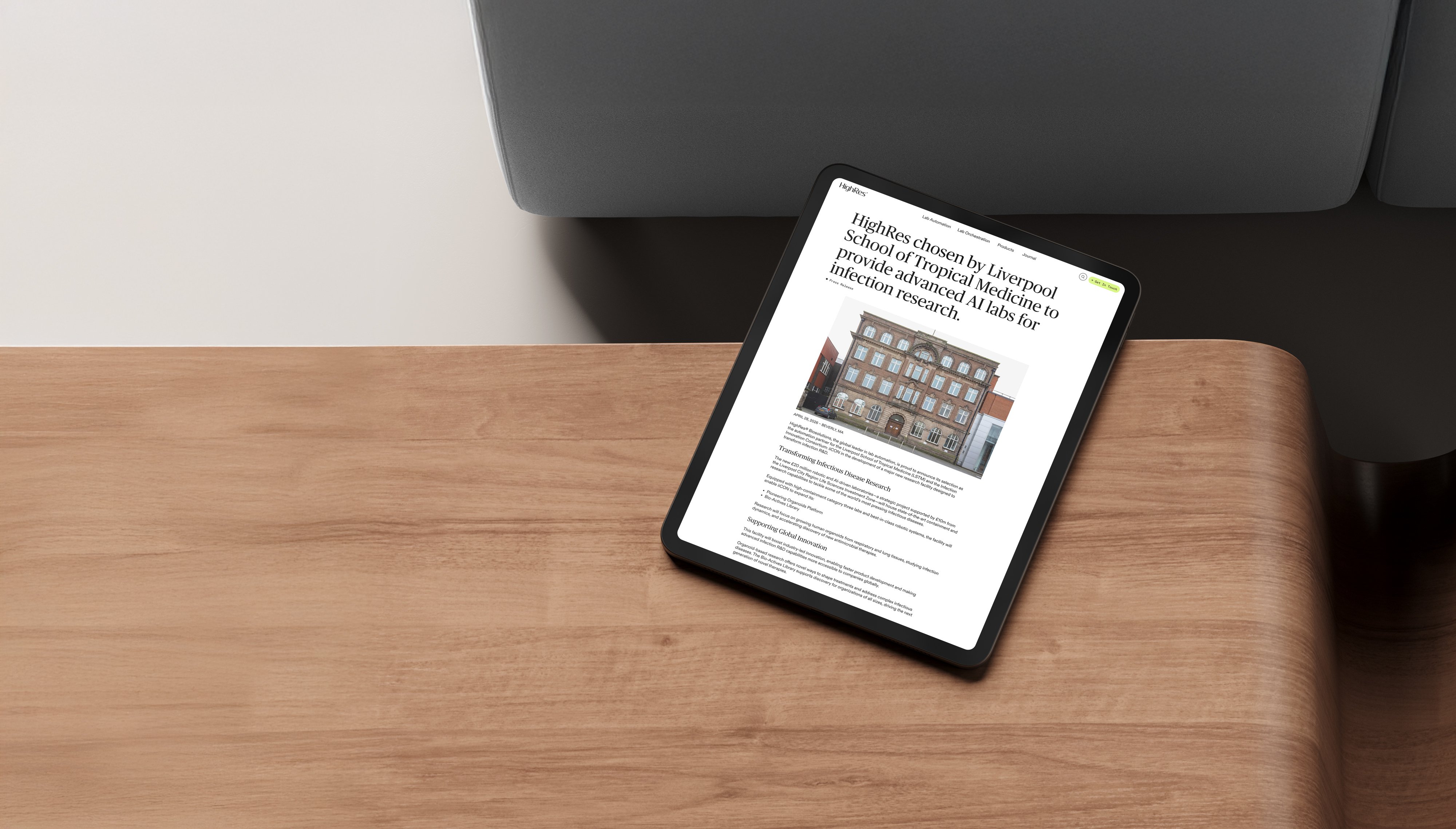


HighRes® partners with life science organizations to implement intelligent data and lab automation workflows that empower every team member to plan and execute efficient and reproducible science. At SLAS2026, HighRes was joined by three distinguished partner organizations — Enveda, Pfizer, and Merck — each sharing their real-world experiences building and evolving high-throughput screening and sample management platforms powered by HighRes automation.
This customer spotlight series features the stories and insights shared by each partner, offering a window into the practical challenges, strategic decisions, and operational outcomes that define world-class lab automation in drug discovery.
Customer Spotlight: Merck
Presented by Sevan Ibabekci, Associate Director of Engineering, Discovery Sample Management (DSM), & Joe Cowan, Principal Scientist, DSM
About Merck Discovery Sample Management
Merck's Discovery Sample Management (DSM) team at the Rahway research site manages one of the most complex compound logistics operations in pharmaceutical discovery. With over 25 years of combined experience in sample management automation, Sevan Ibabekci leads a team responsible for processing millions of samples annually across multiple HighRes automation systems.
Their presentation covered the end-to-end integration of request fulfillment with HighRes automation, the evolution of their systems over time, and the key lessons learned through years of real-world operation.
HighRes® partners with life science organizations to implement intelligent data and lab automation workflows that empower every team member to plan and execute efficient and reproducible science. At SLAS2026, HighRes was joined by three distinguished partner organizations — Enveda, Pfizer, and Merck — each sharing their real-world experiences building and evolving high-throughput screening and sample management platforms powered by HighRes automation.
This customer spotlight series features the stories and insights shared by each partner, offering a window into the practical challenges, strategic decisions, and operational outcomes that define world-class lab automation in drug discovery.
Customer Spotlight: Merck
Presented by Sevan Ibabekci, Associate Director of Engineering, Discovery Sample Management (DSM), & Joe Cowan, Associate Principal Scientist, DSM
About Merck Discovery Sample Management
Merck's Discovery Sample Management (DSM) team at the Rahway research site manages one of the most complex compound logistics operations in pharmaceutical discovery. With over 25 years of combined experience in sample management automation, Sevan Ibabekci leads the DSM Automation team, which supports the HighRes automation systems used to process millions of samples annually by Joe Cowan and the rest of DSM’s fulfillment organization.
Their presentation covered the end-to-end integration of request fulfillment with HighRes automation, the evolution of their systems over time, and the key lessons learned through years of real-world operation.
The Integrated Workflow: From Request to Fulfillment
Merck's compound fulfillment workflow is built around a deep integration between Scigilian's Request system, Mosaic LIMS (version 9, currently being upgraded from v7), and HighRes Cellario® via the Cellario Fulfillment Module (CFM) and Cellario Order Broker (COB).
- Researchers submit compound requests through Scigilian Request, specifying volume, concentration, plate type, and serial dilution requirements
- Orders flow into Mosaic's order fulfillment system, where available inventory is validated against dead volumes for 1.4mL Matrix tubes
- Compatible orders are surfaced in CFM for selection by the operator, with options for block replication or block cherry-pick processing
- Selected orders pass through COB for final configuration, scan-and-validate, and submission to Cellario
- Cellario orchestrates execution on the HighRes cells, including robotic arm movements, liquid handling, and plate routing
This integrated stack allows Merck to process standard program requests, one-off orders, large compound library plates (handled directly in Mosaic), and emerging acoustic dispensing requests — all within a unified, auditable workflow.
Three HighRes Systems in Operation
Primary Sample Management Cells (Mirror Pair)
Merck operates two identical HighRes sample management cells — mirror images of each other — each equipped with dual Prime® Liquid Handlers, six 1.4 mL tube decappers, a 0.75 mL tube decapper, an acoustic tube decapper, a HighRes MicroSpin, and D2 reagent dispenser from UK Robotics for which HighRes wrote a custom driver. Both cells utilize Denso robots, upgraded from legacy KUKA arms.
The Prime's ability to swap liquid handling heads on the fly, including an IZ8 independent-channel head, low- and high-volume 96-well heads, and a 384-well head, provides the flexibility to handle a wide range of tube-to-plate and plate-to-plate reformatting orders. Tray pooling is another key feature of the Prime, allowing two plates to be processed at the same time by simultaneously pipetting liquid and grabbing tip boxes from the below-deck storage, enabling increased throughput. Heads can be shipped back to HighRes for calibration during preventive maintenance, minimizing downtime.
The Denso upgrade from KUKA was driven by KUKA's reduced support for smaller pharmaceutical automation customers. While Denso robots required the addition of machine guarding (as they are not collaborative robots), the transition delivered significantly improved reliability — last year was the highest-volume year ever processed on these cells, running flawlessly throughout an extended campaign.
MC199: The Evolving First-Generation System
MC199 is Merck's original HighRes system, inherited from the Pennsylvania site in 2017. Over nine years, it has undergone continuous evolution — from an original configuration of four acoustic dispensers and a Microblast Air Knife to a modern system featuring an Echo, AmbiStore, D2 dispenser, MicroSpin, Bravo liquid handler on a permanent FlexCart, and Azenta acoustic decappers.
In 2024, Merck completed a major Phase 1 upgrade of MC199, replacing end-of-life devices and upgrading software to Cellario 4.2. Looking ahead, the team plans to replace the aging KUKA arm with a Nucleus® ZCell pod, add a second Echo on a cart to support growing acoustic dispensing demand, and install cameras for remote monitoring.
"Over nine years we've slowly upgraded [our first] system. The cool part about working with HighRes is that the cart and [dock] system makes it very easy to reconfigure, so the robots can always reach what they need to.
Sevan Ibabekci
Associate Director of Engineering, Discovery Sample Management at Merck
Video 1. Merck’s Automation Journey
Lessons Learned
Sevan and Joe highlighted several themes:
- Engage stakeholders early and deeply. Understanding both current and long-term needs drives better system design.
- Build flexible systems. HighRes cart architecture makes reconfiguration and upgrades significantly easier than fixed-installation alternatives.
- Involve IT from the start. Getting Cellario OS approved for the Merck network is a major undertaking requiring extensive testing and IT partnership.
- Safety and machine guarding are non-negotiable. Merck's transition to Denso required full machine guarding. Plan for this in both space and budget.
- Service contracts are a lifeline. Merck's premium support contract with HighRes enables quick turnaround on parts and repairs, including Prime head exchanges, minimizing downtime.
- Budget for unknowns. Post-FAT and post-production, new requirements inevitably emerge. Reserve budget for enhancement cycles.
- Staff skill sets matter. Automation-fluent team members keep systems running longer and more reliably.
- Document everything. Tracking all management of changes, especially liquid class modifications, enables rollback when issues arise.
- Cameras save hours. An intermittent crash on MC199, caused by a robot speed setting interacting with AmbiStore arm timing, was only diagnosed by recording video overnight. Cameras are now standard on all new systems.
Key Outcomes
- Record compound processing volumes achieved in the most recent campaign on the primary sample management cells
- Nine years of continuous system evolution on MC199 demonstrate long-term platform viability and upgradability
- Deep integration between Scigilian Request, Mosaic, CFM, COB, and Cellario enables end-to-end auditable fulfillment
- Denso robot upgrade delivered measurable reliability improvements over legacy KUKA configuration
Download Joe & Sevan’s slides here.
Questions?
Contact our applications and technology experts for personalized advice, recommendations, and demonstrations! Learn more about Merck or reach out to Sevan or Joe about their systems.