
What if a single compact genomics workstation could process 3,072 samples in eight hours, a task that would take a skilled technician nearly two full work weeks to complete manually? The Prime® NGS Workstation from HighRes does exactly that and it processes eight plates simultaneously (Video 1; Fig. 1).
For genomics labs under pressure to scale throughput without scaling headcount, the Prime NGS Workstation arrives as a genuinely compelling answer. Built around HighRes’ own compact liquid handler — the Prime — this system integrates a carefully chosen suite of peripheral instruments into a cohesive, walk-away automation platform purpose-built for NGS library prep in 384-well format.
Video 1. Prime NGS Workstation is one of the few systems on the market specifically designed for 384-well NGS workflows, enabling laboratories to process thousands of samples per day with minimal manual intervention and the lowest cost per sample possible.
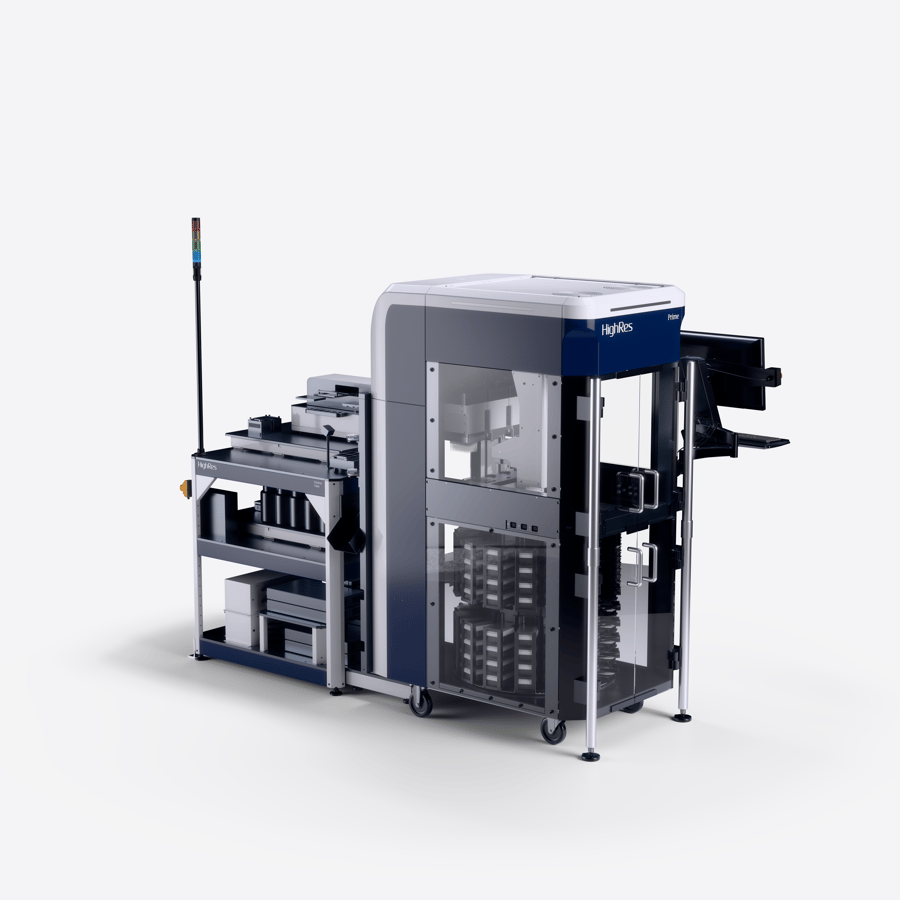
Figure 1. Rendering of the Prime NGS Workstation, featuring the HighRes Prime Liquid Handler and including integrated instruments like the Formulatrix Tempest, BlueCatBio BlueWasher, Inheco ODTC, and more.
The Peripheral Stack: Every Instrument Earns Its Place
Each instrument integrated into the Prime NGS Workstation was chosen based on reducing costs and consumables and ensuring high-quality miniaturized library preparation. This means fewer pipetting steps, more parallel processing, and lower consumable costs.
- Formulatrix Tempest Dispenser: Non-contact dispensing for reagents including magnetic beads, significantly reducing tip usage.
- QInstruments BioShake: Handles all shaking steps, freeing the liquid handler for pipetting tasks.
- HighRes PlateOrient + Barcode Scanner: Ensures correct plate orientation and tracks samples via barcode throughout the run.
- BlueCatBio BlueWasher: Configured for 384-well plates with a built-in magnetic plate for bead-based clean-up steps.
- Up to 4× Inheco ODTCs (On-Deck Thermal Cyclers): Positioned on the bottom level, the ODTCs handle all thermal cycling steps fully in parallel with other operations.
- 8 plates processed per run
- 8 hours total unattended run time
- 384-well plate format for miniaturized reactions
- Manual equivalent: ~6 hours per person, per plate
Key Performance Figures
The Prime Liquid Handler: Compact but Capable
At the heart of the system is the Prime itself: a compact liquid handler engineered for high throughput, efficiency, and flexibility. Its pipetting deck features two dynamic trays and one fixed tray, enabling a technique called tray pooling: while one tray is actively pipetting, the other is being loaded with new labware. The result is near-continuous pipetting with minimal idle time.
Beneath the deck, the Prime houses generous ambient storage for labware and tips, enough to sustain the entire eight-plate workflow and then some. A collaborative robotic arm shuttles plates between storage, the deck, and all the peripheral instruments on the back of the system, keeping everything moving without human intervention.
Prime NGS Workstation is described as a “Prime-driven” system: you essentially need the Prime itself plus a table with a few instruments on top. No sprawling automation infrastructure required. It’s engineered for labs where footprint matters as much as throughput.
The 384-Well Advantage: More Samples, Less Reagent
The economics are simple: by miniaturizing reactions into 384-well format, the Prime NGS Workstation lets your lab run up to five times as many samples for the same reagent cost. What used to be a budget for 1,000 samples now stretches to 5,000, turning lower well volumes into one of the most impactful cost levers in your entire NGS workflow.
Combined with the Tempest dispenser handling bulk reagent additions, bypassing tip-based pipetting for those steps entirely, the system is engineered at every level to keep consumable consumption lean.
The Bottom Line: Set It and Forget It
The Prime NGS Workstation’s value is straightforward: load your plates in the morning, start the run, and return at the end of an eight-hour day to high-quality NGS libraries. A task that would take a single scientist approximately six hours of manual work — for just one plate — is replaced by a fully automated run producing eight plates without operator intervention.
HighRes positions this as the most efficient workstation of its kind on the market, and the combination of tray pooling, parallel thermal cycling, non-contact dispensing, and miniaturized 384-well chemistry gives that claim a strong technical foundation.