
When you walked into Application Alley in our booth at SLAS earlier this year, you weren't just looking at hardware. You're looking at two decades of hard-won expertise across some of the most demanding application spaces in life science distilled into systems that are designed to solve real problems, for real labs, at real scale.
We used Application Alley as a showcase for exactly that: a curated collection of automation systems, both physical and virtual, that demonstrate what's possible when deep application knowledge meets flexible, modern instrumentation.
Here's a closer look at what we showed and why it matters.
Cellario Lab Designer™: Build Your Lab Before You Build Your Lab
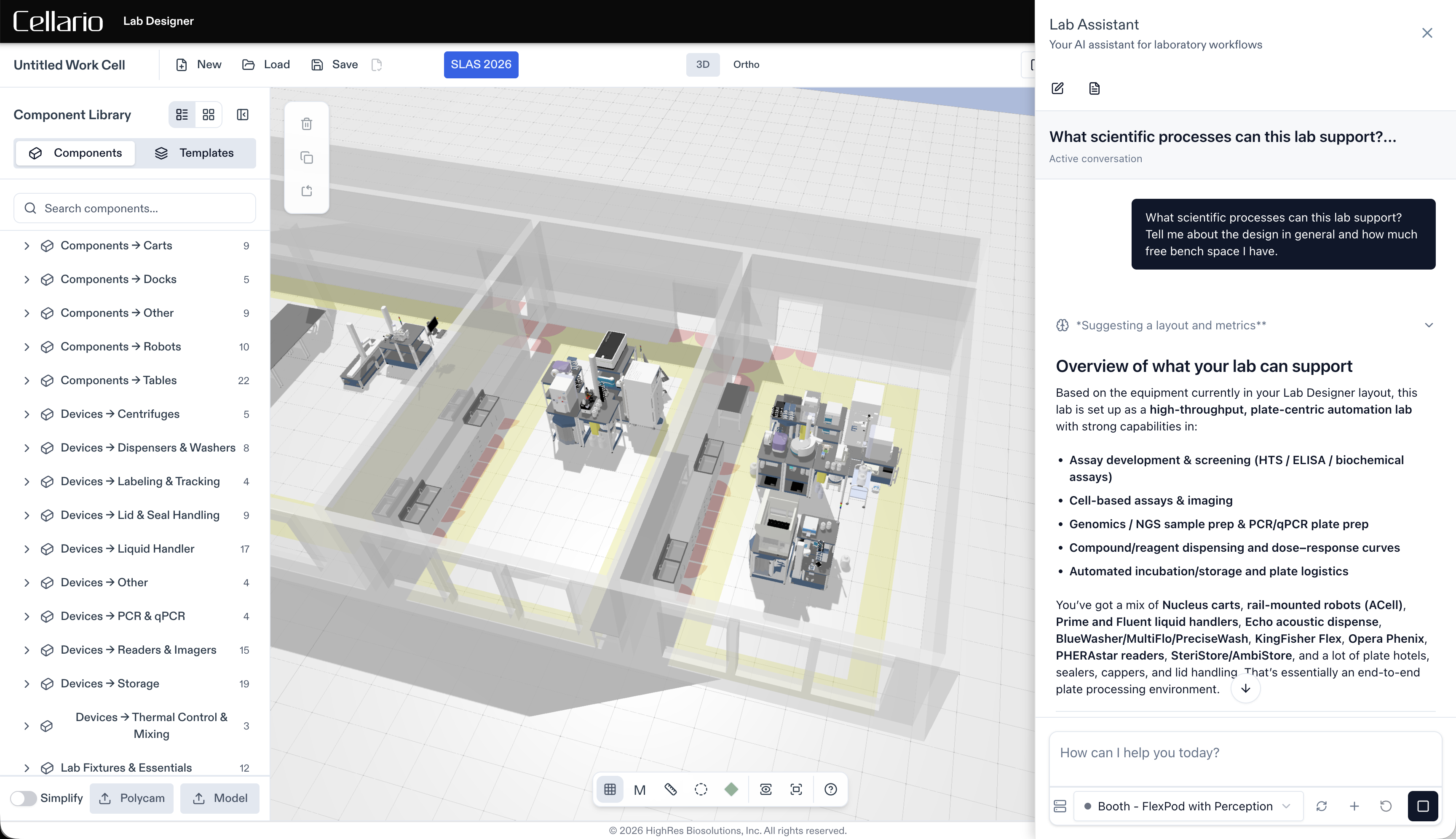
One of the most exciting things we showed at SLAS wasn't physical hardware at all: it was our new Cellario Lab Designer™, a fully interactive 3D design tool that lets you visualize, configure, and plan your automated lab environment before a single piece of equipment ships (Video 1).
Think of it as a digital sandbox for automation. You can log in, load a layout, add or remove instruments, swap out components, and see exactly how your system would look and function — all in a rich 3D environment. It's a powerful tool for evaluating options, getting stakeholder buy-in, and making smarter decisions earlier in the process.
We used the Lab Designer at SLAS to showcase three complete virtual system concepts — systems we've designed and can build, presented as interactive 3D models rather than static renderings or spec sheets. Visitors could see the systems in context, understand their flexibility, and even explore how individual components could be modified or swapped.
Video 1. HighRes' Application Alley Demo video, featuring Prime NGS Workstation and Cellario Lab Designer.
Three Virtual Systems: A Glimpse at What's Possible
High-Throughput Genomics System
This system is built for high-throughput library prep using a generalized, kit-agnostic workflow, but it's equipped to handle the full range of genomics work, including PCR, assemblies, and more.
One design feature worth highlighting: pre/post-amp separation. In NGS workflows, keeping pre-amplification and post-amplification operations physically separate is critical for data quality. This system is configured with pre-amp on one side and post-amp on the other — and in a real lab deployment, the two could be connected via conveyor through a wall, or kept completely isolated using the Auto Pod for sample transport. It's the kind of thoughtful, application-aware design that only comes from doing this work for a long time.
Flexible Screening System
This is the configuration for labs that want maximum versatility. Equipped with a wide range of readout options, including high-content imagers and multi-mode plate readers, and built around a Nucleus® dock and cart architecture that lets instruments be added, removed, or swapped based on the application at hand.
In the Lab Designer demo, we show just how flexible this really is: adding an Agilent Bravo tip-based liquid handler to complement an Beckman Echo acoustic dispenser for transfer applications, swapping a FLIPR in or out depending on the protocol, and exploring different readout combinations, all in real time, in 3D.
If your screening needs span multiple modalities, assay types, or throughput levels, this architecture is designed to grow with you.
Synthetic Biology & Cell Line Development System
This system is purpose-built for the front end of synthetic biology workflows – specifically, cell line development work involving transfection, cell maintenance, and quality control monitoring.
It features automated electroporation via a Nucleofector, alongside standard liquid handling for chemical transfection protocols. Heating and cooling, centrifugation, plate washing for media changes, and two incubators round out the cell maintenance capabilities. For readouts, it's equipped with a ZE5 flow cytometer and a Yokogawa high-content imager, with additional carts for further instrument flexibility.
And for labs running end-to-end synthetic biology workflows: this system can be paired with the genomics system described above, using the AutoPod™ to transport DNA assembly products directly into transfection — seamlessly connecting upstream and downstream operations.
The Prime® NGS Workstation: Big Capability, Small Footprint
On the floor, we had Prime® NGS Workstation: a compact, all-in-one automated 384-well library prep platform built around the Prime liquid handler (Fig. 1).
The Prime NGS Workstation delivers a purpose-built solution for high-throughput NGS library preparation, enabling laboratories to achieve scalable, fully automated workflows with significantly reduced cost per sample. By combining miniaturized 384-well processing, precision liquid handling, non-contact dispensing, and integrated robotics, it eliminates the inefficiencies and consumable burden of traditional systems. With on-deck thermal cycling, tip-free reagent addition and cleanup, and the ability to process multiple plates hands-free in parallel, Prime NGS provides a standardized, reliable platform for reproducible, high-density library preparation at scale.
Figure 1. Rendering of HighRes' Prime NGS Workstation, featuring the HighRes Prime Liquid Handler and including integrated instruments like the Formulatrix Tempest, BlueCatBio BlueWasher, Inheco ODTC, and more.
The Prime NGS Workstation is designed to support virtually any NGS library prep kit, and we're actively validating kits that will be available as prepackaged, turnkey purchases. Whether you're running low-input whole genome sequencing, exome capture, or RNA-seq, this system is built to handle it — without requiring a warehouse to house it.
If bench space is precious (and in most labs, it is), the Prime NGS Workstation deserves a close look. Watch the full demo video of this system.
More Than a Trade Show Showcase
Application Alley isn't just a display of what we've built. It's a demonstration of what we can build just for you.
Every system on display reflects a category of automation challenge that we've solved, in some form, for labs like yours. The Prime NGS Workstation was born from the need for compact, accessible library prep automation for 384-well plates – something that is virtually nonexistent in genomics automation marketplace. The flexible screening system reflects years of work with drug discovery and high-content screening teams. The synthetic biology system reflects the growing complexity of cell line development workflows and the need for integrated, automated solutions.
Cellario Lab Designer is how we bring those conversations to life earlier in the process so that by the time we're specifying hardware, we've already aligned on the vision.
Let's Talk About Your Application
If any of these systems sparked an idea — or if you're sitting on an automation challenge that doesn't fit neatly into a standard category — we'd love to hear about it. Our applications team works across the full spectrum of life science workflows, and we've built custom automation solutions for everything from standard genomics to highly specialized cell biology applications.
Book a demo. Talk to our team. Let's co-create something built for your science.
Interested in a closer look Cellario Lab Designer? Contact us to schedule a demo or express your interest in our Early Access Beta Program.